Sanitary Evaporators for
Food & Dairy Industry
Food processing and dairy plants generate high-volume, moderate-BOD effluent with fats, oils, proteins, and lactose. Rototech supplies sanitary-grade falling film and forced circulation evaporators in SS316L for effluent concentration, ZLD compliance, and by-product recovery — engineered for hygiene-critical environments.
Food & Dairy Effluent Challenges
High FOG Loads
Fats, oils, and grease (FOG) at 500–5,000 mg/L from meat processing, edible oil plants, and dairy operations cause severe fouling of heat transfer surfaces and demand pre-treatment before any evaporation can proceed.
Hygiene & Material Standards
Food-grade plants demand SS316L metallurgy with electropolished surfaces, FDA-compliant gaskets, CIP provisions, and no dead-leg pipework — requirements that standard industrial evaporators do not meet.
Seasonal Capacity Variation
Sugar mills, dairy farms, and food processors have distinct seasonal peaks — crushing season, milk flush. ZLD systems must be designed for peak capacity while remaining operable at reduced loads during off-season periods.
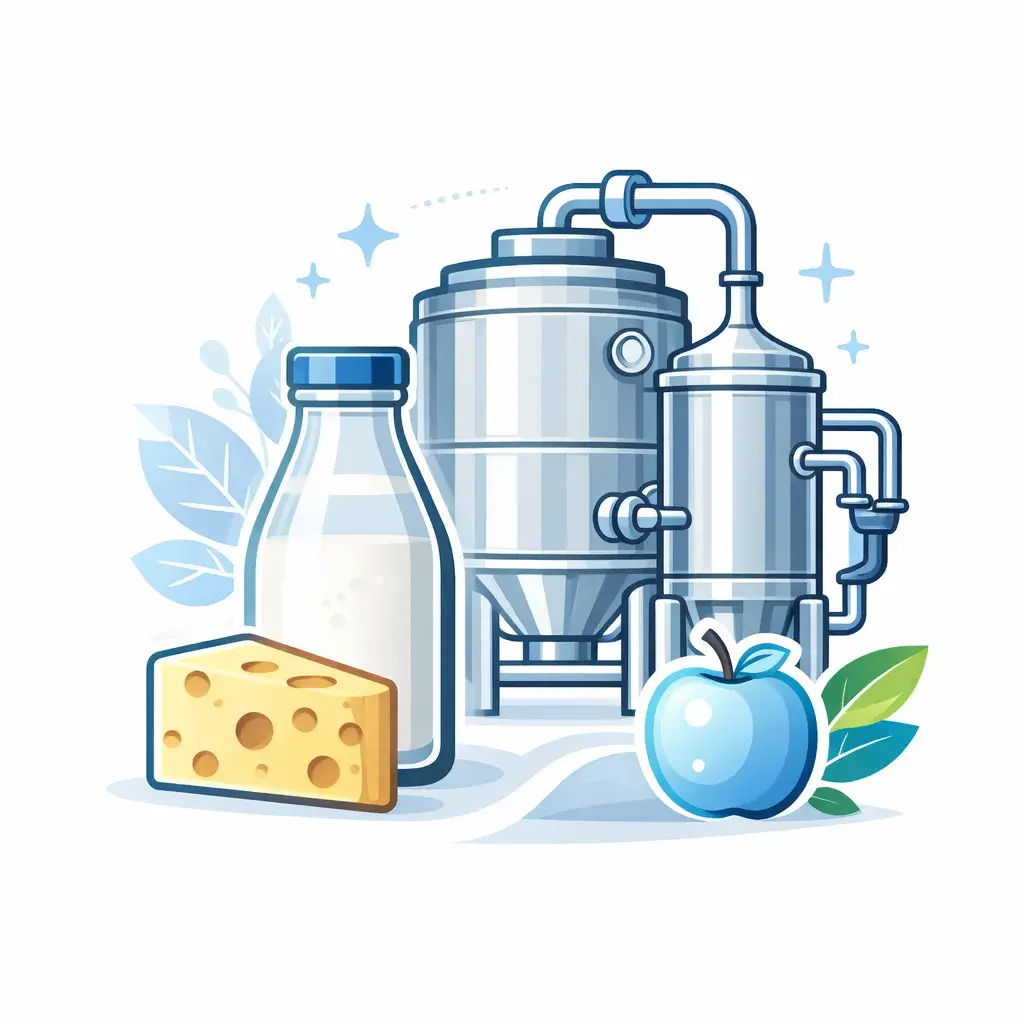
Sanitary Design. Full ZLD.
Rototech designs food and dairy evaporation systems from the ground up for hygienic operation — SS316L construction, automated CIP, and scalable capacity to handle the seasonal variation typical of agri-food processing.
- Phase 1: DAF or centrifugal FOG separation — reduces FOG below 50 mg/L before evaporator entry.
- Phase 2: Sanitary Falling Film MEE or MVR — SS316L, CIP-ready, low-temperature vacuum operation.
- Phase 3: Spray Dryer or ATFD converts concentrate to dry powder or salt cake with potential by-product value.
- Phase 4: Condensate reuse — clean distillate returned for process utility or boiler feed.
Core Technologies for Food & Dairy:
Food & Dairy ZLD Questions
What evaporator design is required for food and dairy effluent?
Sanitary-grade Falling Film Evaporators in SS316L with electropolished tube interiors, CIP connections, and food-grade gaskets. Low-temperature vacuum operation prevents protein denaturation and lactose caramelisation. FOG pre-treatment via DAF is required for streams above 100–200 mg/L fat.
How does Rototech handle high FOG loads from dairy or meat processing?
FOG above 50–100 mg/L rapidly fouls falling film tubes. We integrate DAF or centrifugal fat separators upstream to reduce FOG below the threshold. Separated FOG sludge is dewatered independently, and the clarified effluent enters the sanitary evaporation system.
Can dairy membrane permeate be treated to achieve ZLD?
Yes. Dairy UF/RO permeate has low fouling tendency and suits falling film MEE or MVR well. The concentrated retentate is dried via spray dryer (for powder recovery) or ATFD (for ZLD solid disposal), recovering all dissolved solids and achieving zero liquid discharge from the membrane plant.
Food-Grade Evaporation. Full ZLD Compliance.
Share your food or dairy process effluent volumes and Rototech will design a sanitary, CIP-ready evaporation system matched to your seasonal capacity profile.